pages/blog/bujo.md (view raw)
1 2 3 4 5 6 7 8 9 10 11 12 13 14 15 16 17 18 19 20 21 22 23 24 25 26 27 28 29 30 31 32 33 34 35 36 37 38 39 40 41 42 43 44 45 46 47 48 49 50 51 52 53 54 55 56 57 58 59 60 61 62 63 64 65 66 67 68 69 70 71 72 73 74 75 76 77 78 79 80 81 82 83 84 85 86 87 88 89 90 91 92 93 94 95 96 97 98 99 100 101 102 103 104 105 106 107 108 109 110 111 112 113 114 115 116 117 118 119 120 121 122 123 124 125 126 127 128 129 130 131 132 |
---
template:
atroot: true
slug: bujo
title: The quest to optimize productivity
subtitle: This blog is devolving into a techbro cliché
date: 2021-11-04
---
Us folks in tech have this general obsession with productivity. It's all
about getting the workflow _just right_. Or at least, that's the goal.
Heck, there are entire companies built around optimizing productivity in
specific workflows -- email, notes, tasks, etc. Suffice to say, there's
a lot of activity in this space.
I've heard reports of varying degrees of success with these tools, from
"OMG it like, totally changed how I take notes!", to "I'm not sure it's
worth paying $30 per month for a mail client" (yeah, you know the
one)[^1]. However, I will never use these tools. Primarily because I
don't trust them -- I don't trust them with my data; more importantly, I
don't trust them to exist long enough before they decide to thank me for
their incredible journey and "sunset" their product.
[^1]: In case you didn't, I'm talking about Superhuman.
That said, I wasn't entirely opposed to digital solutions. I tried
a method called the OBTF, or the One Big Text File. It's what it says on
the tin: a single text file to manage everything -- tasks, email,
meetings, notes, habit tracking, etc. Its effectiveness relies on your
text editor's ability to search for things. I even came up with my own
"syntax" to help accelerate finding relevant bits. It looked like so:
```
wed, 03 nov
some task here // DONE
another task here
a note here
meet foo @ 12:30 // CANCELLED
```
I don't exactly recall why I stopped doing it, but I did. Maybe because
I tried to do way too many things all at once. It also meant I needed to
be at my computer to update tasks -- some of which were offline/IRL.
Yeah, you can see where this is going. You probably guessed it from the
post slug. That's right -- bullet journaling. Well, sort of -- let me
explain.
The [bullet journal method](https://youtu.be/fm15cmYU0IM) is a somewhat
involved process. I recommend watching the video since I'm going to skip
explaining how bullet journaling works. The method I use draws
inspiration from bullet journaling -- but just mostly the task symbols
and daily/weekly logs. These are the symbols I use:
- `•` is a new task
- `×` is a completed task
- `>` is a task that's been carried forward
- `~strikethrough~` is a cancelled task
- `-` represents a note
And somewhat less commonly, `⊙` (a circled dot) to scribble a small note
pertaining to that task, i.e. reason for cancellation, delegation, etc.
Tasks are sometimes broken down into further subtasks represented as a
checkbox `□`. Ticking off a checkbox feels great.
Tasks are grouped under a weekly list, running from Monday to Sunday. I
had previously done daily lists, but that... didn't really work out.
Here's what happened:
```
mon, 01 nov
> long task here
× something else
tue, 02 nov
> long task here
wed, 03 nov
> long task here
...
```
See the problem? Most often, my tasks tend to span an entire week. While
I could theoretically break it down into subtasks, stuff like "Write an
RFC for Foo Service" are just that. It's a big task, and I can't really
break it down. Hence, the running weekly log.
I can't go without posting what it actually looks like in my notebook;
so here, have a FOIA-declassified-looking picture of my bullet journal.
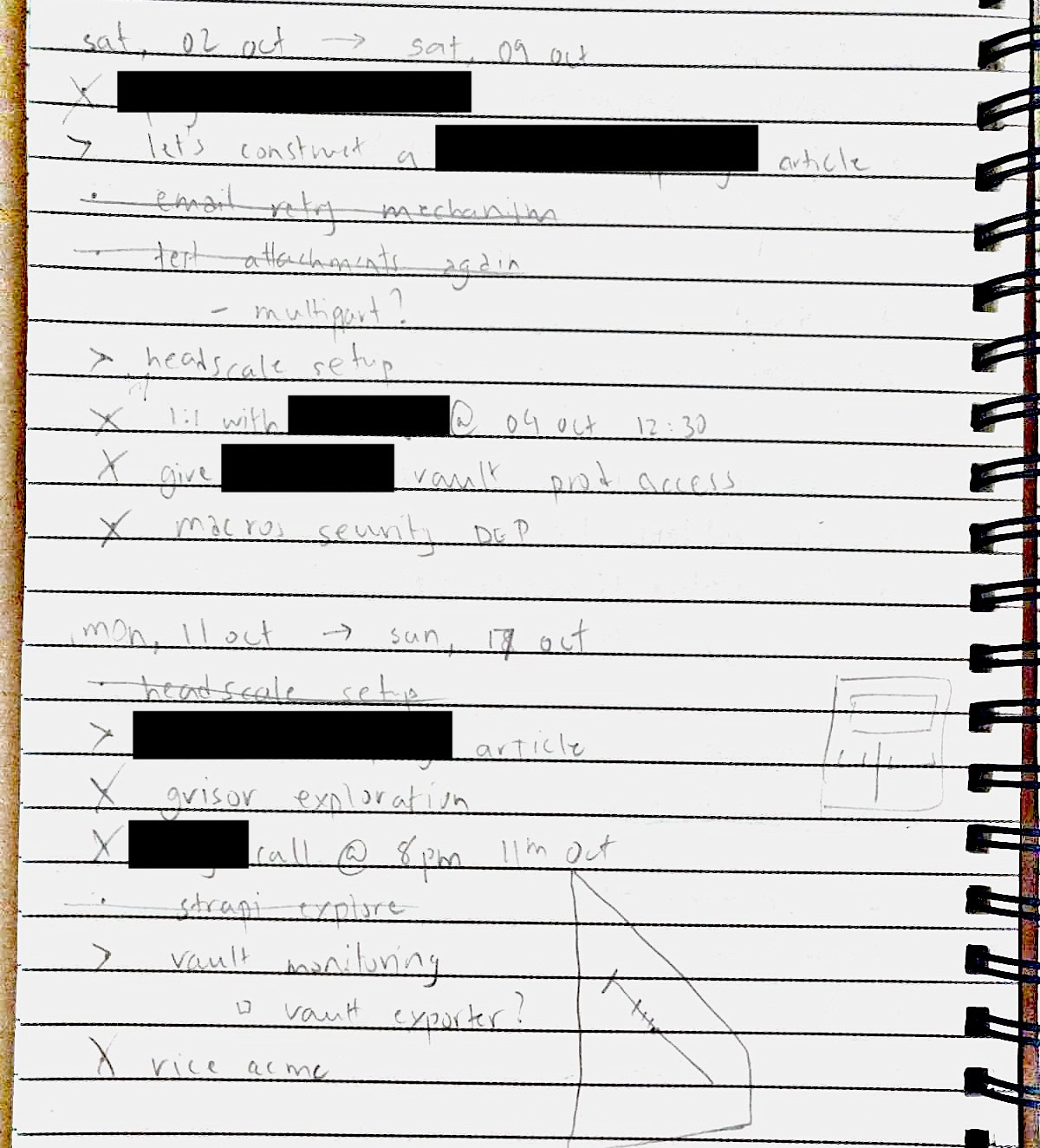
This was when I first attempted the weekly log. Evidently, I struggled
to compute dates accurately. And yes, "rice acme" was a task -- one
that I promptly completed, I'll have you know.
I use a pencil to write. There's no real reason for it, but I started
the book with a pencil and I plan to continue with it until I finsh this
notebook -- there's still about half of it left. I plan to cop a dotgrid
notebook for my next one, and start using a pen.

At first I was sceptical. I didn't think I'd stick to it. But hey, looks
like I did. I've been using my bullet journal spinoff method to great
success for the past 6-odd months. Have I become more productive? I
don't know, but I can confidently state that my head has become
"lighter". I no longer have to _remember_ tasks; I can simply offload
them to my journal.
I think the key to making it work was the realization that it's not
"perfect". I put perfect in quotes because I had this notion of an
all-in-one, flawless productivity tool that'll take care of everything,
from anywhere. I then embraced the fact that some tasks don't really
need noting down and it's ok to _not follow the rules_. I guess what I'm
trying to say is -- don't force it; use the journal loosely.
No self-help-productivity-bullshit-post is complete without a list of
tips, so here it is:
- Make it your own. Don't attempt to shoehorn someone else's solution.
- Don't try to manage everything -- that hardly ever works.
- Don't over optimize. Task states don't need 20 different symbols. Keep
it simple.
- It doesn't have to be an art project[^2]. I know mine isn't. Keep it
functional.
[^2]: I'm looking at you,
[r/bulletjournal](https://old.reddit.com/r/bulletjournal).
Okay, this self-help-productivity-bullshit-post is now complete.
|